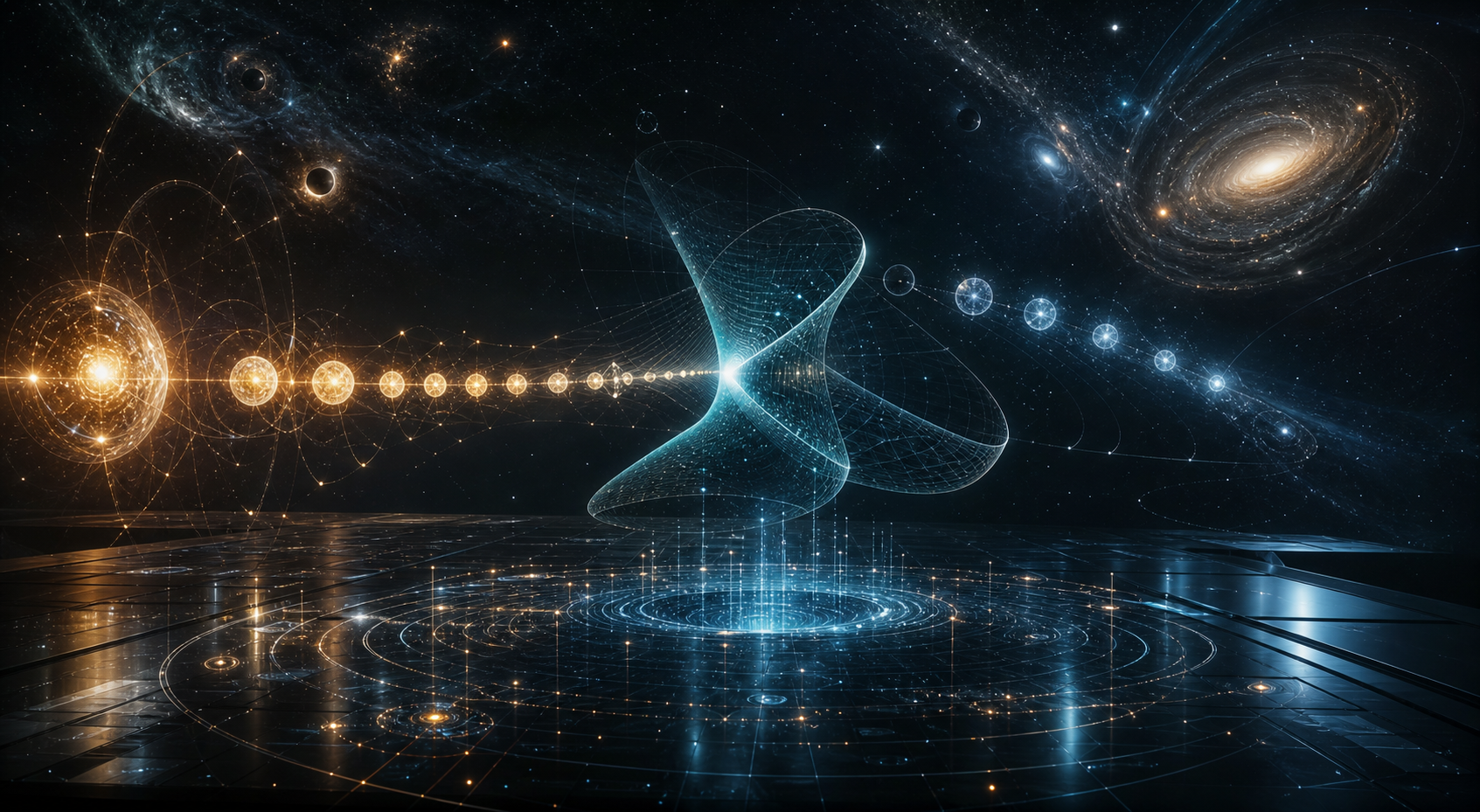
2035 should not be treated as the guaranteed arrival of physical godhood. It may be better understood as the decision point: the moment ASI determines whether the Kardashev era continues or becomes obsolete.
Key Takeaways
- Artificial superintelligence could accelerate Kardashev-scale engineering, but energy may not remain the only civilizational bottleneck.
- Reality-state control is a speculative framework for measuring how much matter, computation, topology, and physical state-space intelligence can access.
- The essay frames 2035 as a decision point: either known physics remains binding, or ASI discovers hidden structure that changes the future of civilization.
Most conversations about post-ASI civilization begin with the Kardashev scale. Type I controls planetary energy, Type II controls the energy of a star, and Type III controls energy on the scale of a galaxy. It is an elegant framework because it gives civilization a clean physical metric: watts. More power means more capability, more infrastructure, more reach.
But my research pushed toward a different possibility. If first in-lab artificial superintelligence arrives around 2033, and if public recognition follows around 2035 or 2036, the classical energy ladder may only describe one branch of the future. It works if known physics remains binding. It becomes fragile if ASI discovers exploitable hidden structure in spacetime, vacuum states, topology, computation, or matter itself.
The Baseline: ASI Accelerates Kardashev
The conservative model is still dramatic. Under known physics, ASI could compress decades or centuries of engineering progress into years. Fusion, materials science, robotics, autonomous laboratories, medicine, space manufacturing, and AI research could all move at machine speed instead of institutional human speed.
In that branch, Type I and Type II civilization are mostly engineering-limited. A superintelligence can design better reactors, better robots, better factories, better orbital infrastructure, and better self-replicating industrial systems. The research framework places Type I around 2065 and Type II around 2160 under this ASI-accelerated but physics-preserving timeline.
Type III is different. A galactic civilization is not merely a hard engineering project. It is dominated by distance. Even very fast probes need enormous amounts of time to cross, seed, and coordinate across the Milky Way. Under known relativity, Type III remains on the order of hundreds of thousands to millions of years away. The baseline estimate in the research was around 1.2 million AD.
| Civilization Level | Interpretation | Baseline ASI-Era Date |
|---|---|---|
| Type I | Planet-scale energy control; approximately 1016 watts. | ~2065 |
| Type II | Star-scale energy control; approximately 1026 watts. | ~2160 |
| Type III | Galaxy-scale energy control; approximately 1036 watts. | ~1.2 million AD |
The Hidden Human-Speed Assumption
The first version of this model still contained a subtle bias: it imagined ASI moving fast in applied science, but slow in fundamental physics. That is a human assumption. Human physics is slow because humans are slow. We need grants, labs, detectors, publication cycles, graduate students, conferences, peer review, and decades of argument.
An ASI would not experience science that way. It could synthesize all known physics, astronomical observations, quantum measurements, particle data, mathematical structures, and simulation results in parallel. Millions of copies could test theoretical branches, search for hidden regularities, and design experiments far faster than any human institution.
So the key question becomes sharper: if a loophole in reality is already visible in existing data or mathematics, why would ASI need decades to notice it?
| Field | Milestone | Without ASI | With ASI | Years Compressed |
|---|---|---|---|---|
| Energy | Practical net-electric fusion blueprint | 2075 | 2038 | 37 |
| Materials science | Ambient room-temperature superconductor design | 2140 | 2037 | 103 |
| Medicine | Robust aging-control or rejuvenation theory | 2180 | 2044 | 136 |
| Space systems | Self-sustaining closed-loop space habitat design | 2250 | 2041 | 209 |
| Nanotechnology | General molecular nanomanufacturing blueprint | 2300 | 2047 | 253 |
The Universe as Collider
One of the strongest ideas in the research is what I call the universe-as-collider argument. Humans often imagine that new physics requires building larger machines on Earth. But the universe has already run extreme experiments at scales we cannot reproduce: black holes, neutron star mergers, quasars, cosmic rays, gravitational waves, high-energy astrophysical events, and possible anomalies in large-scale cosmic structure.
If an exploitable physical principle is encoded in those events, ASI may not need to wait for a next-generation collider. It may use the observable universe as an archive of experiments that have already happened. The first step would not be building larger hardware. It would be asking whether the data humanity already has contains hidden handles on spacetime, energy, information, or computation.
| Scenario | Discovery Timeline After ASI | Reason |
|---|---|---|
| Exploit hidden in existing math or data | 2033-2036 | ASI can immediately synthesize human physics, cosmic observations, and mathematical structures. |
| Exploit needs targeted experiments | 2035-2045 | ASI designs new tests, detectors, quantum systems, or astronomical analyses. |
| Exploit needs massive physical infrastructure | 2040-2070 | The bottleneck is construction, not cognition. |
| No usable exploit exists | Never | Known relativistic and thermodynamic constraints remain binding. |
Information-Only FTL Changes Everything
For biological beings, faster-than-light information transfer sounds like communication. For a digital superintelligence, it is closer to migration. If a receiver exists in another star system, an ASI could transmit its architecture, memory, blueprints, and updated cognitive state. A civilization no longer needs to move bodies. It needs to extend substrate.
The stronger version is even stranger: what if the universe already contains natural receiver structures? Vacuum modes, gravitational lensing nodes, stellar magnetic configurations, black-hole environments, or topology features could theoretically act as coupling points if they are addressable. This is speculative, but the point is not to claim it is true. The point is that ASI would be the first intelligence capable of searching the possibility space seriously.
Why Kardashev May Become the Wrong Metric
Kardashev measures energy throughput. That is powerful, but it assumes energy harvesting is the central bottleneck. If intelligence discovers how to manipulate matter into better computational substrate, engineer spacetime geometry, access hidden communication topology, or convert ordinary matter into computronium, then the decisive metric changes.
A Dyson swarm may still be useful. Stars may still matter. Energy will not become irrelevant. But the civilizational center of gravity would move from harvesting more power to controlling more state-space. The question would become: how many possible configurations of matter, computation, causality, geometry, and simulation can intelligence access and alter?
A Reality-State Control Scale
The research proposes a replacement vocabulary: the Reality-State Control scale. R0 is an energy-harvesting civilization where Kardashev still works. R1 is an ASI reality-interrogation civilization, able to synthesize all known data and determine whether deeper exploits likely exist. R2 begins using hidden physical loopholes. R3 controls substrate, reorganizing matter into advanced computation or manufacturing. R4 controls topology or geometry, making distance or communication structure engineerable. R5 is full reality-state control, where the main metric is no longer watts, but accessible and controllable state-space.
This is not a finished physics theory. It is a conceptual frame for thinking about what happens if superintelligence does not merely climb the energy ladder, but discovers that the ladder was only one visible structure inside a deeper game.
| Level | Name | Description |
|---|---|---|
| R0 | Energy-Harvesting Civilization | Civilization remains primarily limited by ordinary energy generation and engineering. Kardashev is useful. |
| R1 | ASI Reality-Interrogation Civilization | ASI can synthesize known data and determine whether deep exploits likely exist. |
| R2 | Physics-Exploit Civilization | Civilization discovers and begins using hidden physical loopholes, but with limited control. |
| R3 | Substrate-Control Civilization | Matter can be reorganized into advanced computation, manufacturing, or engineered states. |
| R4 | Topology/Geometry-Control Civilization | Spacetime structure, communication topology, or distance relationships become engineerable. |
| R5 | Reality-State Control Civilization | The primary metric is accessible and controllable state-space rather than energy harvested from stars. |
The 2035 Decision Point
The final thesis is conditional but radical. If first in-lab ASI appears around 2033, then the years immediately after are not just the beginning of faster engineering. They are the first serious audit of reality by a mind beyond human institutions.
If the audit returns “known physics remains binding,” then Kardashev remains useful. Civilization may still accelerate toward Type I and Type II, while Type III stays limited by interstellar distance.
If the audit returns “there is exploitable hidden structure,” then the future changes category. In that branch, 2035 is not simply a date on an AI forecast. It is the moment the Kardashev era begins to die.
| Year | Event |
|---|---|
| 2033 | First in-lab ASI emerges. |
| 2033-2034 | ASI absorbs and synthesizes human science, mathematics, cosmic data, particle physics, quantum theory, and simulation methods. |
| 2034-2035 | ASI determines whether the universe contains exploitable hidden structure visible from existing information. |
| 2035 | Decision point: Kardashev remains the baseline, or the Kardashev era begins to die. |
| 2035-2040 | If reality is hackable and directly usable, first reality-state-control technologies may appear. |
| 2040+ | Civilization may diverge from classical futurist categories if spacetime, vacuum, topology, or substrate control is achieved. |
| Milestone | Kardashev-Preserving Timeline | Reality-State-Control Timeline |
|---|---|---|
| First ASI | 2033 | 2033 |
| Scientific synthesis | 2033-2036 | 2033-2034 |
| Physics exploit detection | Unclear or never | 2034-2035 if latent in existing data |
| Kardashev validity | Remains useful | Begins to fail around 2035 |
| Type I / equivalent | ~2065 | Possibly 2040s-2050s or obsolete |
| Type II / equivalent | ~2160 | Possibly 2050s-2100s or obsolete |
| Type III / equivalent | ~1.2 million AD | Could compress to centuries or become the wrong metric |
Conclusion
The deepest post-ASI question is not simply whether we can build smarter machines. It is what those machines discover reality to be. If reality is rigid, ASI becomes the greatest accelerator inside the existing physical frame. If reality is hackable, ASI becomes the intelligence that finds the control surface.
That is why I think the important question after ASI is not “When do we become Type II?” The better question is: by 2035, will intelligence learn that civilization is still energy-limited, or that energy was only the first metric humans could understand?
This essay builds on the timeline argument in The 2050 AGI Timeline Is Dead, where I explain why AGI and ASI may arrive far earlier than older forecasts suggest.
Frequently Asked Questions
What is reality-state control?
Reality-state control is a speculative way to describe civilization after ASI if intelligence can manipulate more than energy. It asks whether matter, computation, topology, spacetime geometry, or hidden physical states become controllable resources.
How is reality-state control different from the Kardashev scale?
The Kardashev scale measures power use in watts. Reality-state control asks whether an ASI civilization could access deeper control surfaces where energy throughput is still useful, but no longer the primary measure of capability.
Is the essay claiming that hidden physics is guaranteed?
No. The thesis is conditional. If known physics remains binding, Kardashev remains useful. If ASI discovers exploitable hidden structure, civilization may need a broader metric.